What a hard water spot actually is.
Every drop of tap, bore or irrigation water carries dissolved minerals — mostly calcium and magnesium. When a drop lands on glass and dries, the water leaves and the mineral does not. What is left is a tiny ring of solid deposit.
Do that a few hundred times over a summer of sprinkler overspray and you get the cloudy, spotted pane most people blame on the cleaner. A cloth and a bucket will not touch it, because you are trying to wipe away something that is chemically stuck to the surface.
The point where it stops being removable.
This is the bit worth knowing before you leave it another season. Glass is not perfectly smooth — it is slightly porous, and mineral deposits slowly work into that surface. Given enough heat and enough time, the deposit etches the glass itself.
Once it has etched, no product removes it, because there is nothing sitting on top any more — the surface is physically pitted. At that stage the only fixes are professional glass polishing or replacement, both of which cost far more than a clean.
Practically: spotting from this summer will come off. Spotting that has baked on through three or four Central Otago summers on a north-facing pane may not. If you have a window like that, it is worth getting looked at now rather than next year.
What actually removes it.
Removal is a chemical job, not a scrubbing job — you need to dissolve the mineral, then get it off before it redeposits.
- A mild acid, matched to the deposit. Household white vinegar handles light, recent spotting. Heavier deposits need a proper oxalic or phosphoric-based glass restorer.
- Dwell time, not pressure. The acid has to sit long enough to break the bond. Scrubbing a dry pane harder just risks scratching it.
- A non-scratch pad, never a scourer. Steel wool and green kitchen pads leave fine scratches that catch light worse than the spotting did.
- A full neutralising rinse. Leftover acid keeps working on frames, seals and any aluminium joinery it runs down onto.
- Never on a hot pane in direct sun. The product flashes off before it works and can leave its own marks.
A warning about tinted and coated glass.
Plenty of newer Wānaka builds have low-E, self-cleaning or film-tinted glass. Acid restorers can destroy the coating, and it is not reversible — you will trade spotting for a permanent patchy haze.
If you are not certain what your glass is, test somewhere invisible first, or get someone to look at it. This is the most common way a DIY hard-water job turns into a glazing bill.
Stopping it happening again.
Removal is the hard part. Prevention is genuinely easy, and it is nearly always the same one fix.
- Move the sprinklers. Irrigation overspray hitting glass is the cause in the overwhelming majority of cases I see around Wānaka and Hāwea. Ten minutes adjusting heads saves the pane.
- Check where downpipes and spouting overflow. Water running off a roof picks up minerals and grit on the way down.
- Squeegee shower glass after use. Same chemistry, smaller pane, and the worst offender in most houses.
- Clean with pure water. Water filtered to zero minerals cannot leave a deposit, because there is nothing in it to leave.
Why I use pure water for this.
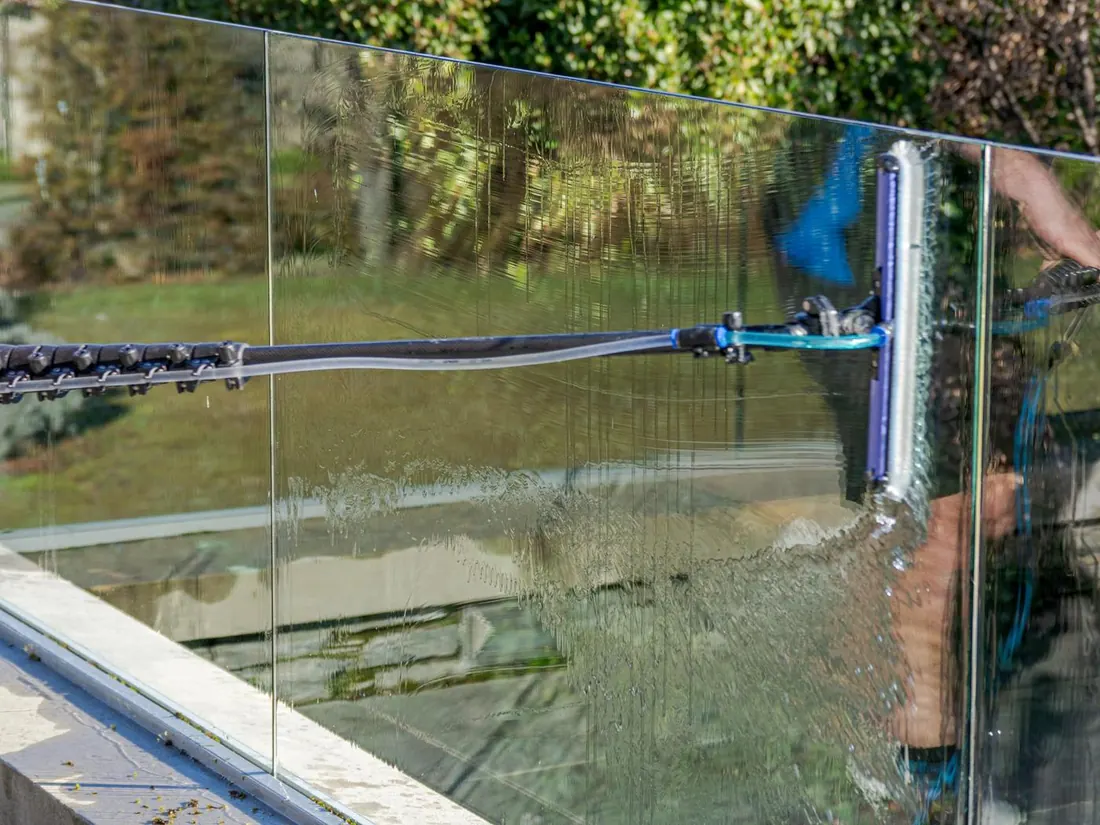
My system strips the minerals out before the water ever touches the glass. It rinses the pane and then dries off it leaving nothing at all — no spotting, and no detergent film for dust to stick to afterwards.
For a window that is already spotted, the sequence is restore first, then maintain with pure water so it does not come back. If you have a pane you have given up on, send me a photo before you decide it is beyond saving — most of them are not.
Common questions